
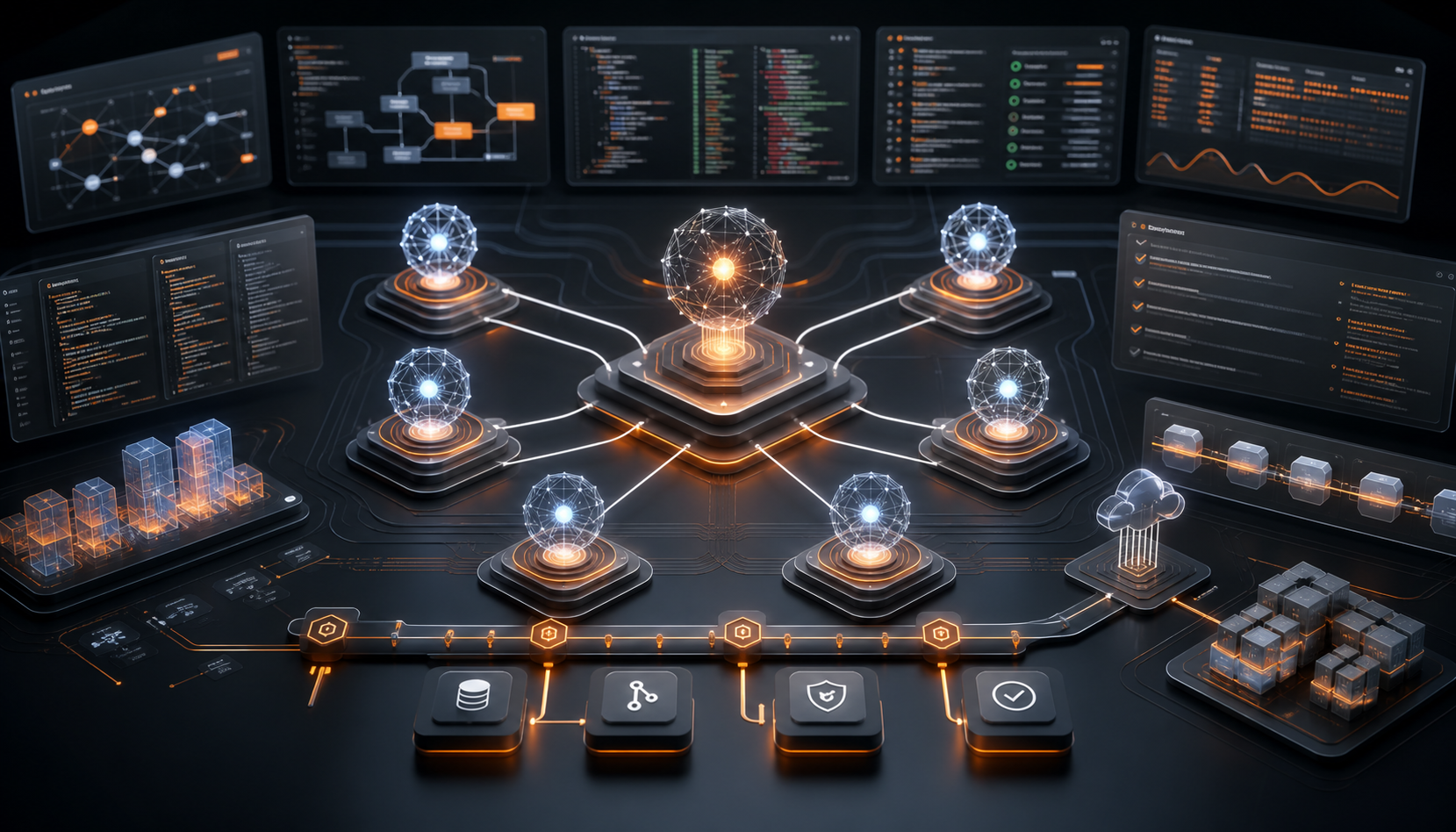
Agentic AI SDLC is the disciplined use of AI agents across the software development life cycle. It is not simply asking a model to generate code. A mature approach uses specialised agents for discovery, design, implementation, review, testing, security, release and operations, then coordinates their work through human oversight, version control, evaluations and delivery governance.
The value comes from orchestration. A single assistant can help with a task, but an agentic delivery system can route work between planning, coding, documentation, testing and quality-review roles. Each agent should have a defined responsibility, a limited set of tools, clear inputs and outputs, and measurable criteria for success.
What Makes the SDLC Agentic?
An agentic SDLC has three important characteristics. First, agents can act on software artefacts through controlled tools such as repositories, issue trackers, documentation systems, test runners and deployment pipelines. Second, agents can maintain working context across a workflow while still respecting permissions and data boundaries. Third, the process includes evaluation and feedback loops so agent output can be reviewed, corrected and improved.
This does not remove engineers, architects, analysts or product owners. It changes their leverage. Human teams define the goals, constraints, architecture, acceptance criteria and release decisions. Agents accelerate research, drafting, implementation, checks and documentation where the workflow is suitable.
Agent Roles Across the Life Cycle
-
Discovery Agent
Summarises requirements, identifies missing information, maps stakeholders and turns rough ideas into structured backlog candidates.
-
Architecture Agent
Assists with option analysis, integration boundaries, data flows, risk registers and decision records for the human architect to review.
-
Development Agent
Implements scoped changes, follows repository conventions, updates tests and explains trade-offs in code-review language.
-
Quality Agent
Runs checks, reviews accessibility, validates edge cases, compares outputs to acceptance criteria and flags regressions.
-
Security Agent
Looks for unsafe data handling, exposed secrets, weak validation, dependency risks, prompt-injection paths and excessive permissions.
-
Operations Agent
Monitors logs, release notes, incidents, cost signals and performance metrics, then escalates anomalies for human investigation.
Designing the Workflow
The safest agentic SDLC workflows begin with small, auditable scopes. Each agent should receive enough context to complete its task, but not unrestricted authority over the whole system. Tool access should be explicit. Repository writes, production changes, customer data access and external communications should require appropriate review and approval.
Good workflow design also separates creative model work from deterministic engineering checks. Agents can propose implementation plans, draft code and explain assumptions. Build systems, tests, linters, schema validation, security checks and deployment policies should still provide objective gates before changes move forward.
Evaluation and Governance
Agentic delivery needs repeatable evaluation. Teams should maintain examples of expected outputs, known failure cases, regression tests and review checklists. For code work, this includes build results, unit and integration tests, accessibility checks, security scans and human code review. For analysis and documentation work, it includes factual grounding, source traceability, clarity, completeness and tone.
Governance should answer practical questions: which agents can access which systems, which actions require approval, how prompts and model outputs are logged, how sensitive data is protected, how errors are escalated and how cost or latency is monitored.
Delivery Pattern
- Start with the workflow: define the human process before adding agents.
- Define agent boundaries: give each agent a role, tool set, context window and escalation rule.
- Use retrieval carefully: connect agents to approved documentation, tickets, data models and code references.
- Keep humans in control: require review for architecture decisions, security-sensitive changes and production releases.
- Measure behaviour: track quality, completion rates, rework, hallucination risks, cost, latency and user feedback.
- Iterate responsibly: improve prompts, tools, tests and data sources based on observed evidence.
Practical Outcome
Agentic AI SDLC is useful when it makes software delivery more consistent, better documented and easier to review. The strongest implementations are not uncontrolled autonomous systems. They are orchestrated delivery workflows where agents assist the team, evidence is captured, checks are repeatable and humans remain accountable for business and production decisions.